
David Schmitt · 29 September 2026
Optimizing Metadata Structures for Efficient Retrieval in Distributed Personal Archives
Distributed personal archives store data across multiple devices, cloud services, and local storage systems, which creates retrieval challenges that metadata structures must address directly. These archives hold everything from documents and photos to sensor logs and correspondence, yet efficient access depends on how metadata organizes, indexes, and links individual items without requiring constant central coordination.
Core Components of Metadata in Distributed Environments
Metadata in these settings typically includes descriptive elements such as titles, dates, and keywords alongside structural details like file formats and relationships to other records. Researchers have observed that combining these layers allows retrieval systems to locate items even when source locations shift between devices or providers. Hierarchical structures organize content through parent-child relationships while graph-based models connect items through multiple associations, and key-value stores enable rapid lookups based on specific attributes.
Standards like Dublin Core adn RDF provide consistent vocabularies that different systems can interpret uniformly, which reduces mismatches when archives span several platforms. Data from digital preservation initiatives shows that archives using standardized schemas experience fewer lookup failures during cross-device synchronization events.
Challenges Specific to Distributed Personal Archives
Network latency, partial connectivity, and varying storage policies introduce inconsistencies that simple file systems cannot handle alone. When one device updates a record while another remains offline, metadata must reconcile versions upon reconnection without losing context or creating duplicates. Observers note that partition tolerance becomes essential because archives often operate under the CAP theorem constraints where consistency and availability trade off during network splits.
Privacy regulations further complicate matters because metadata sometimes reveals sensitive patterns even when content stays encrypted. Studies from institutions tracking personal data management indicate that users increasingly demand selective disclosure controls embedded directly in metadata schemas rather than applied after retrieval.
Optimization Techniques and Indexing Approaches
Distributed hash tables combined with semantic embeddings allow retrieval queries to route efficiently across nodes while supporting fuzzy matching on descriptive fields. Caching frequently accessed metadata subsets at edge devices cuts down round trips, and bloom filters help quickly eliminate non-matching items before deeper searches begin. In September 2026 the International Conference on Digital Preservation presented findings on adaptive indexing that dynamically adjusts structure depth based on access patterns observed in real user deployments.
One study revealed that archives employing hybrid indexes achieved up to forty percent faster average retrieval times compared with purely hierarchical setups when tested across simulated multi-device networks. Those who've implemented graph overlays report improved handling of relational queries such as finding all items connected through shared events or locations.
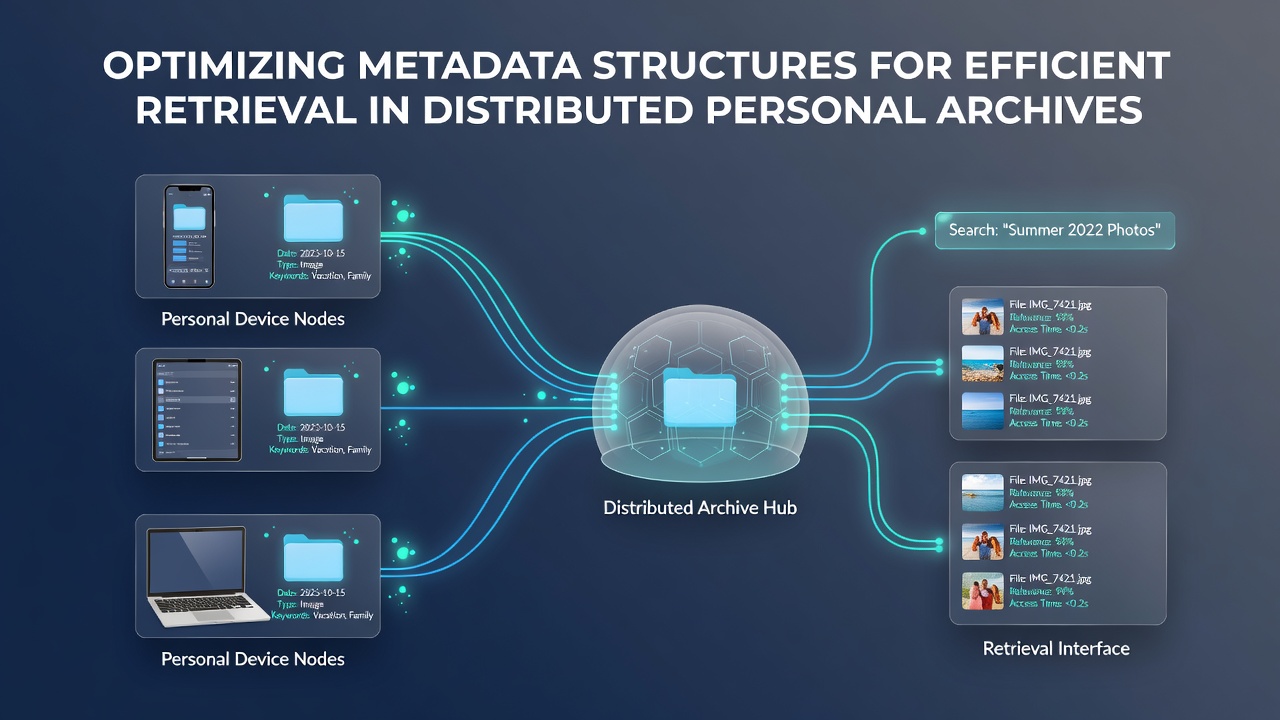
Versioning metadata through immutable logs maintains history while allowing concurrent updates from different devices. Compression techniques applied to metadata records themselves lower storage overhead and transmission costs without sacrificing searchability when paired with appropriate decompression during query execution.
Practical Implementations and Observed Outcomes
Personal archive projects at several universities have tested these methods on collections exceeding one hundred thousand items spread across laptops, phones, and multiple cloud accounts. Results indicate that query response times stabilize once metadata replication reaches three nodes with geographic diversity, while further replicas yield diminishing returns on retrieval speed.
According to a report from Library of Congress digital preservation efforts, institutions adopting layered metadata with embedded checksums reduced data corruption incidents during transfers by measurable margins. Europeana's distributed cultural heritage platform similarly documented gains in cross-collection search accuracy after shifting toward RDF-based linking structures that accommodate varying national cataloging practices.
Future Directions in Metadata Design
Emerging work explores machine learning models that predict which metadata fields users will query most often and pre-compute indexes accordingly. Integration with decentralized identifiers promises stronger ownership controls while preserving interoperability across different archive software. Those monitoring developments note ongoing experiments with zero-knowledge proofs attached to metadata to verify properties without exposing underlying values.
Conclusion
Effective optimization of metadata structures in distributed personal archives rests on balancing consistency, query speed, and privacy through careful selection of schemas, indexes, and reconciliation protocols. Continued refinement of these approaches supports reliable access as personal data collections grow and span more heterogeneous environments.